
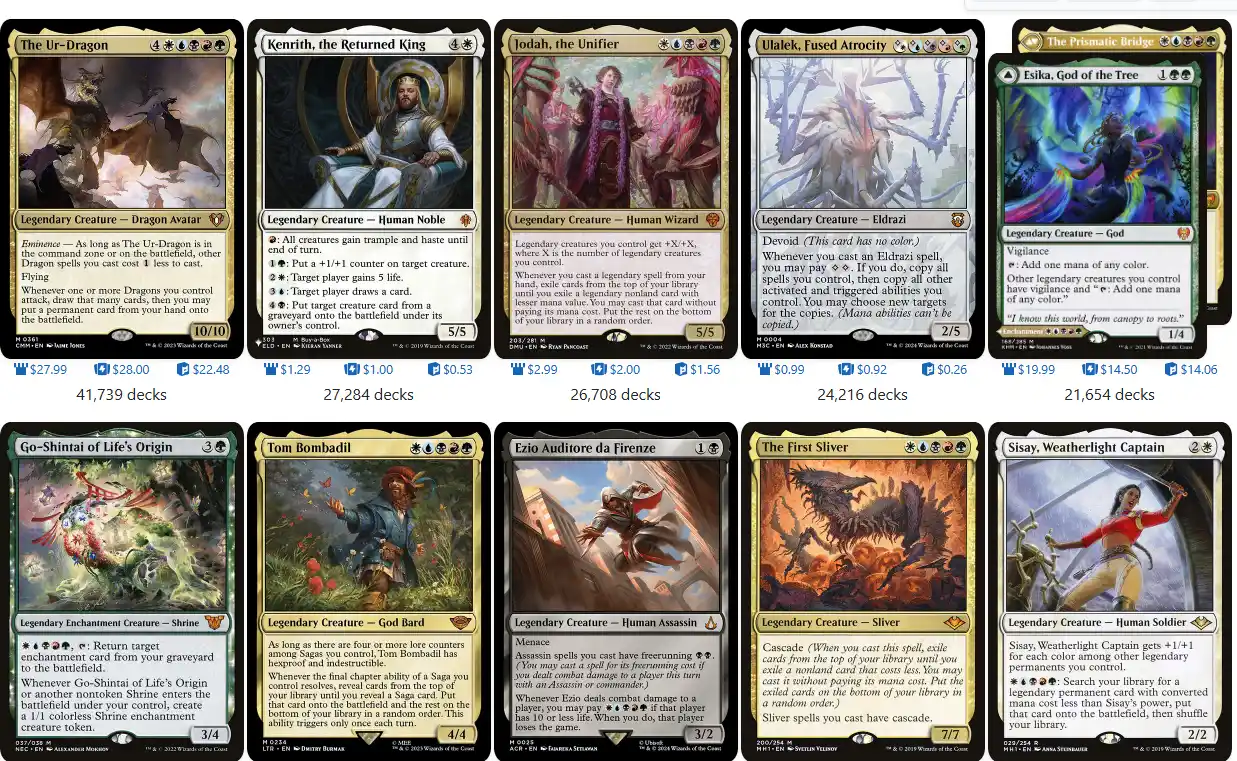
Five-color decks don’t lose because they ran “one fewer land than they should.” They lose because their mana base is doing three jobs at once:
- hit land drops
- fix five colors
- do it fast enough to keep up
The land count is still important. But in 5-color, the types of lands you play matter as much as the number.
TLDR
For “how many lands in a 5-color commander deck,” start at 38 lands.
37 works if your fixing is strong and your curve is lower.
Go to 39–40 if you’re budget, tapland-heavy, or playing lots of expensive spells.
The honest answer: 5-color doesn’t automatically need “more lands”
A lot of players assume five colors means you should jam 40+ lands. But many modern takes land around:
- 37–38 lands as a typical starting range
- then they add enough ramp/fixing to make those lands function
Some guides even frame it as “total mana package” instead of just lands. A common rule is dedicating roughly 50 cards to lands + ramp combined, and then tweaking from there. One five-color mana base guide suggests starting around 37 lands and 13 ramp as that baseline package. That’s a solid mental model because it forces you to plan for both speed and consistency.
So no, you don’t have to run more lands just because you’re 5-color. But you might choose to, depending on budget and curve.
Why 5-color decks still feel mana screwed (even with 37 lands)
Five-color “mana screw” often isn’t “I didn’t draw lands.”
It’s:
- “I drew lands, but not the right colors.”
- “My lands entered tapped, so I’m a full turn behind.”
- “I can cast my ramp, but not my payoffs.”
- “My commander costs five colors and now costs two more. Great.”
This is why some advice bumps land counts slightly for 5-color decks—not because the deck needs more total mana than other decks, but because:
- you want more chances to naturally see the right mix of colors
- and you need enough untapped sources to play on curve
One recent Commander land-count overview even says you likely already run 37–38 and suggests bumping toward 38–40 in 5-color to make sure you have enough of each color showing up.
That’s a reasonable approach, especially if you’re not running premium fixing.
The land count ranges that actually work in practice
Here’s the clean version:
37 lands
Works when:
- your curve is modest
- your fixing is high quality
- your ramp package is strong and consistent
This is often where tuned 5-color lists land, because they’re not trying to “draw out of” bad mana. They’re building to avoid it.
38 lands
My favorite default for most 5-color decks.
- It’s one extra land over the classic 37 baseline
- it lowers how often you keep sketchy hands
- and it helps you keep making land drops while juggling colors
39–40 lands
This is common for:
- budget 5-color mana bases
- tapland-heavy builds
- big-mana strategies
- commanders you expect to recast
If your deck wants to cast 6–8 mana spells reliably and you’re not turbo-ramping every game, 39–40 lands is not “too many.” It’s you choosing fewer non-games.
Budget matters more in 5-color than anywhere else
If you’re building 5-color on a budget, you usually end up with:
- more tapped lands
- fewer “any color” lands
- fewer premium dual land options
That tends to slow you down. And once you’re slow, you miss windows. You can have the right colors on turn five… and still be losing because the table started playing the game on turn two.
In that world, adding a land (or two) is a legitimate fix. It won’t solve everything, but it makes your opening hands more keepable and your midgame less fragile.
The easiest way to know you need more lands (or better lands)
Track these two failure modes:
- You miss land drops (especially land 3 and land 4).
That’s a land count problem (or you’re trying to cut too many lands for “cool cards”). - You have lands, but can’t cast spells because of colors.
That’s usually a fixing problem, not a land count problem.
More lands can reduce how often it happens, but the real fix is making more of your lands produce the colors you need when you need them.
If you’re not sure which it is, look at your “bad games” and ask:
- was I short on mana, or short on colors?