

If you have ever heard “my deck is a 7” from someone who then casts a turn-two value engine and never gives the table another meaningful decision, congrats. You have met the reason power level talks feel like herding cats. In Commander, the real game sometimes starts before you shuffle.
TLDR
- Classic “power level 1-10” is a vibe check, not a measurement. It fails because it mashes speed, consistency, interaction, and wincons into one squishy number.
- Wizards’ Commander Brackets (beta) try to fix this by describing game experience + expected game length, not just card strength.
- Brackets are optional. They are meant to help you match pods faster, not replace Rule 0.
- The best pregame pitch is: bracket + how you win + how fast you can realistically end the game + any “heads up” mechanics (combos, extra turns, land denial).
(If you want an easy baseline for ramp, draw, and interaction so your deck actually functions, check MTGEDH.com’s How to Build a Commander Deck (MTG). And if you want an example of a tribe where “table perception” matters almost as much as card quality, see How Viable Are Slivers in MTG Commander?)
Why Commander Power Levels Are So Messy
Commander decks do not live on one axis. They live on at least five, and your “7” might be my “please, no.”
Here are the big knobs that actually change how oppressive a deck feels:
Speed
How early can you present a real win or lock? Not “goldfish Christmasland,” but a real game where people interact.
Consistency
How often do you do your thing? Redundancy, tutors, card selection, and cheap draw make “same game, different opponents” happen a lot.
Interaction quality
A deck with 12 answers but all of them cost four mana plays very differently than a deck with free spells and one-mana interaction.
Win condition style
Combat damage is usually telegraphed. Two-card wins from hand are not. Stax locks are a different kind of “win” that some pods simply do not want.
Resilience
How well do you rebuild after a wipe? If your deck shrugs off interaction, it effectively plays faster than it looks.
This is why the 1-10 scale collapses. It tries to compress a whole profile into one digit. Then every deck mysteriously becomes a 7 because nobody wants to say “I brought a 9.”
The Commander Brackets (Beta) Explained
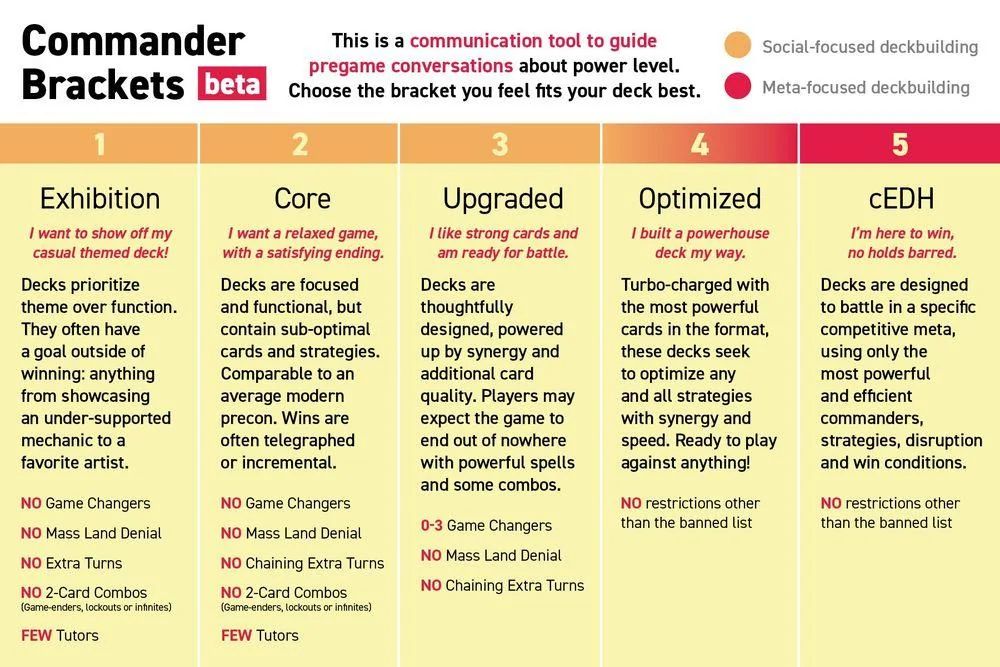
Wizards introduced Commander Brackets as an optional matchmaking tool to help players describe what kind of Commander game they are trying to have. Instead of arguing about numbers, you pick a bracket that matches your deck’s intent and the kind of game you want at the table.
As of the October 2025 beta update, Wizards describes each bracket by expectations and a rough “how many turns should you get to play before you win or lose” guideline:
Bracket 1: Exhibition (theme first)
This is the “look at my weird deck” bracket. The goal is to showcase an idea more than to win efficiently.
Turn expectation: You should expect to play at least nine turns before you win or lose.
What it feels like: jank, story decks, constraints, oddball commanders, and lots of Rule 0 flexibility.
Bracket 2: Core (low pressure, straightforward)
Core is unoptimized, proactive, and social. You are trying to win, but it is usually incremental and disruptable.
Turn expectation: You should expect to play at least eight turns before you win or lose.
Important update: Wizards explicitly decoupled Core from “precon level” because precons vary wildly across products and eras.
Bracket 3: Upgraded (real synergy, real interaction)
This is where decks start feeling “built.” Strong synergy, higher card quality, and meaningful interaction show up, but it is still not “race to turn four.”
Turn expectation: You should expect to play at least six turns before you win or lose.
What it feels like: big turns fueled by resources you have been accruing, plus enough interaction that the table can actually fight back.
Bracket 4: Optimized (high power, no training wheels)
This is high-power Commander. Explosive starts, efficient disruption, tutors, fast mana, and compact win lines all live here.
Turn expectation: You should expect to play at least four turns before you win or lose.
What it feels like: “my deck is doing the strongest version of its plan,” without necessarily being tuned for a specific cEDH metagame.
Bracket 5: cEDH (competitive meta, play to win)
Now you are playing competitive Commander. Decks are designed for efficiency, consistency, and metagame considerations. Social contracts still exist, but the priority is winning.
Turn expectation: These games could end on any turn.
Where “Game Changers” Fit (and Why They Matter)
Brackets also use a “Game Changers” list: cards Wizards considers especially warping, either because they snowball resources, shut people out, tutor too efficiently, or end games in ways many casual pods dislike.
The practical rule is simple:
- Brackets 1 and 2: no Game Changers
- Bracket 3: up to three Game Changers
- Brackets 4 and 5: unlimited Game Changers
One important change from the October 2025 update: Wizards removed the old “tutor restrictions” from bracket definitions and leaned more on Game Changers to catch the most efficient tutors, plus the bracket’s intent and turn expectations to prevent lower-bracket combo nonsense.
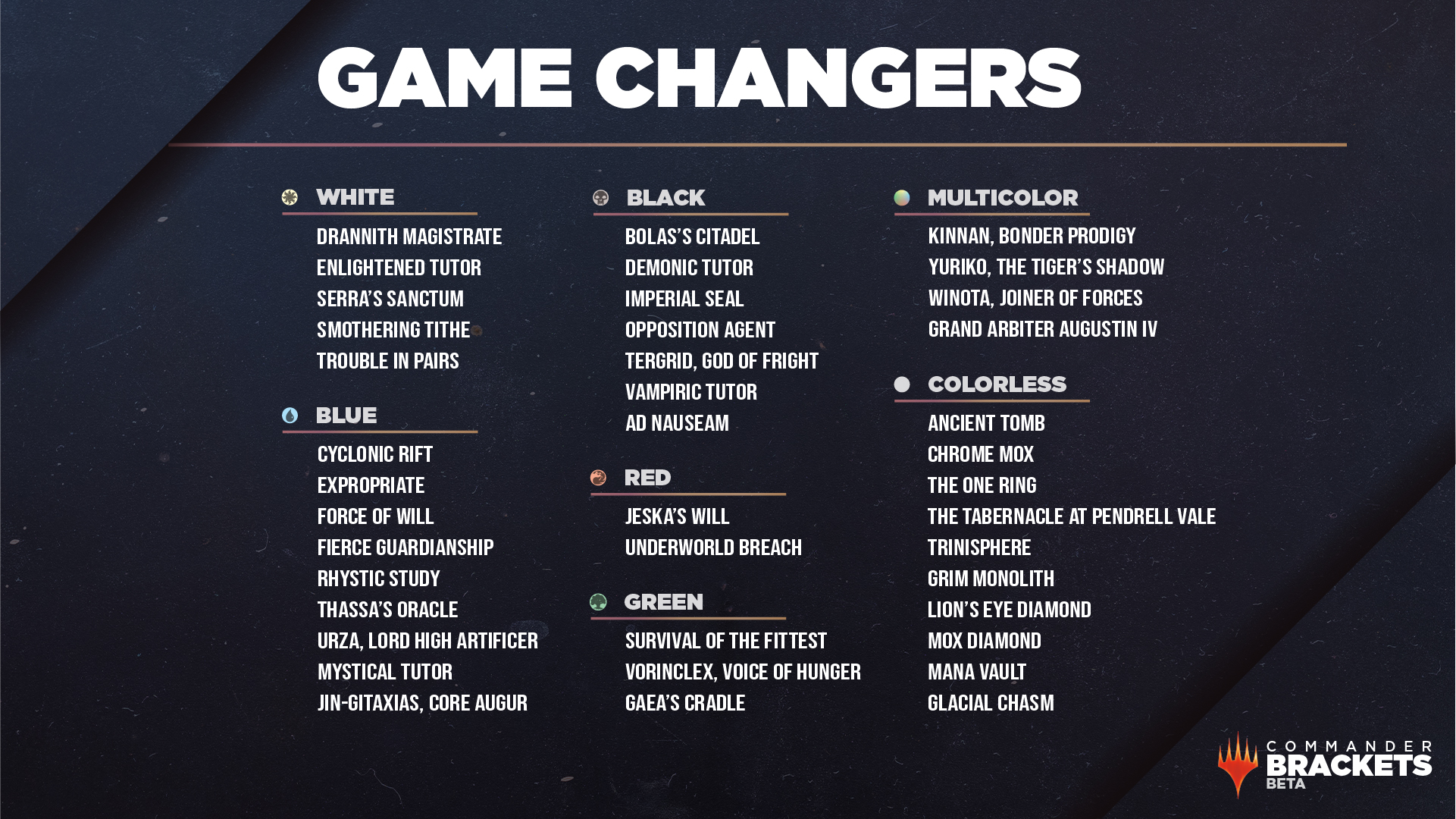
Also worth knowing: the Game Changers list is still evolving. Wizards has added and removed cards as they refine the philosophy. For example, the October 2025 update removed ten cards from the list, including several high mana value haymakers, several commanders that are mostly scary in the command zone, and a couple of “not quite there” inclusions.
Translation: do not treat the list like scripture. Treat it like a signpost.
Brackets vs the Old 1-10 Power Level Scale
A rough mental mapping, if you need one:
- Bracket 1: power level 1-3 (theme decks, jank, hard constraints)
- Bracket 2: power level 3-5 (casual, unoptimized, “let’s play Magic”)
- Bracket 3: power level 5-7 (upgraded, synergy, real interaction)
- Bracket 4: power level 7-9 (high power, efficient wins and disruption)
- Bracket 5: power level 9-10 (cEDH, meta-informed, fastest and tightest)
Do not fight people over the exact numbers. Numbers are for dice, not for emotional support.
How to Place Your Deck in a Bracket in 60 Seconds
Use this mini checklist. You are not trying to be perfect. You are trying to avoid the worst mismatch.
1) What is your deck trying to do?
Combat, combo, control, stax, value engine, group slug, whatever. Say it plainly.
2) How fast can you realistically win or lock the table?
Use the bracket turn expectations as a sanity check:
- if you regularly threaten the game around turns 4-5, you are probably not Bracket 2 or 3
- if you need time to assemble and you are happy with longer games, you are probably not Bracket 4
3) How “from hand” are your wins?
A telegraphed board win reads very differently than “end step tutor, untap, two cards, game.”
4) Are you playing mechanics that spike feel-bads?
Extra turns, mass land denial, heavy stax, repeated tutors into the same line. Even if your deck is not “strong,” it might belong in a higher bracket because the experience is harsher.
5) If you are using brackets, how many Game Changers are in the list?
This is the quick sorting hat. Not the whole story, but a strong first pass.
Copy-Paste Rule 0 Scripts That Actually Work
The 15-second LGS pitch
“Hey, I’m on Bracket 3. I’m trying to win with combat plus a big value turn, and I can realistically close around turn 7-8 if nobody interacts. No mass land denial, no extra turns loops. That cool?”
The high-power heads up
“I’m on Bracket 4, optimized. I have fast mana and tutors, and I can present wins around turn 4-6 depending on interaction. If you want slower, I can swap.”
The cEDH clarity check
“This is cEDH. I’m on a meta list, playing to win, tight mulligans, no spite plays. Everyone good with that?”
You will be shocked how many bad games disappear when you say the quiet part out loud.
Common Mismatches (and How to Fix Them Fast)
“Upgraded” deck at a Core table
Fix: either bracket up, or remove the stuff that makes your deck feel inevitable (fast mana, efficient tutors, compact combos).
“No Game Changers” but still stomping
This is real. Wizards explicitly calls out that a deck can have zero Game Changers and still belong in a higher bracket if it plays like it. If your deck is ruthless and consistent, label it that way.
A precon that is secretly spicy
Some modern precons and premium products hit harder than people expect. If you upgraded mana, tightened the curve, and added tutors, you are not playing “just a precon” anymore. Own it.
FAQs
Are Commander Brackets mandatory?
No. They are optional and still in beta. They are a communication tool.
Do brackets replace Rule 0?
No. If anything, the whole point is to make Rule 0 easier by giving people shared language.
What bracket are precons?
It depends. Wizards originally used precons as a Core reference point, then backed off that tie because precons vary too much. Use intent and how the deck actually plays.
Do tutors automatically push you up a bracket?
Not automatically, and Wizards removed explicit tutor restrictions from the bracket definitions. In practice, efficient tutors increase consistency and make games feel more repetitive, so they often push you toward higher-power expectations anyway.
What is the difference between Bracket 4 and Bracket 5?
Bracket 4 is high power without being a metagame sport. Bracket 5 is cEDH: tuned lists, meta considerations, and play-to-win priority.
Wrap Up
“Power level” is not a number. It is a promise about the kind of game you are bringing to the table.
If you want fewer non-games, start doing this:
- pick a bracket based on intent and realistic speed
- describe how you win
- warn the table about the spicy stuff
And if you ever catch yourself saying “it’s a 7,” at least follow it with one honest sentence about what that means.