
You know that feeling when the table is already doing table-things, and you’re sitting there with two lands, a seven-drop, and optimism?
That’s not “bad luck.” Most of the time, it’s your mana curve quietly sabotaging you.
TLDR
- If you’re doing nothing in the first 3 turns, your deck is functionally starting the game a full turn (or two) behind.
- A “good” Commander mana curve is not about a pretty bell shape. It’s about early plays that matter: ramp, setup, interaction, and cheap draw.
- Use the Mana Curve Analyzer on MTGEDH to spot the real problem fast: your curve + early-game keepability.
- The fastest fix is usually: cut 2–4 expensive cards that are not game-ending, and replace them with 2-mana ramp, 1–2 mana interaction, or cheap draw/filter.
What “mana curve” actually means in Commander MTG
Your mana curve is the distribution of your spells by mana value. Simple.
What’s not simple is Commander math:
- You’re in a longer game with higher life totals.
- You have access to mana rocks and ramp that don’t exist the same way in other formats.
- Your commander is always available, which can change what “on time” even means.
So the question is not “Is my average mana value reasonable?”
The question is: Can my deck consistently do something productive before turn 4?
Because if you can’t, you’re giving the table free time. And free time is how people assemble engines, set up inevitability, or just run you over while you’re still admiring your hand.
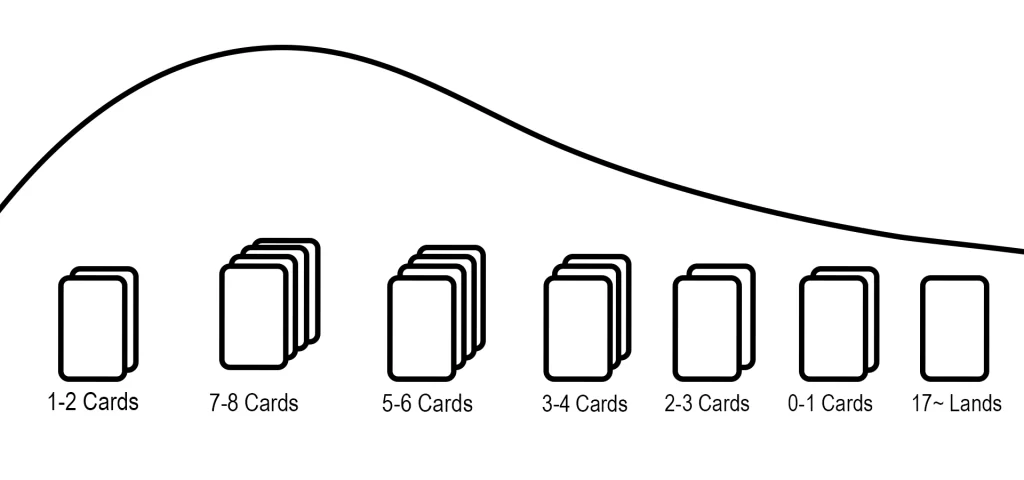
The MTGEDH Mana Curve Analyzer: what to look at first
When you paste a decklist into the Mana Curve Analyzer, you’re looking for two things:
- Where your deck is clustered on the curve
- Whether your opening hands are actually keepable (in real games, not in theory)
Here’s the key: a deck can have a “reasonable” average mana value and still be a disaster if its early turns are empty or filled with cards you cannot realistically spend mana on early.
A one-mana protection spell you plan to hold up is not the same as a one-mana play you’re happy to cast on turn 1.
The three curve problems that make Commander decks lose
1) The Museum Curve (too many 4–7 mana “cool cards”)
This is the classic: your deck is stuffed with haymakers, but you’re not building the runway to cast them.
Symptoms
- Your curve spikes hard at 4–6 mana.
- Your first meaningful spell is often turn 4.
- You keep hands that look “powerful” and then die with five cards in hand.
Fast fix
- Pick three expensive cards that are not:
- your best finisher,
- your best comeback tool,
- or central to your plan,
and cut them.
- Replace them with 2-mana ramp (Arcane Signet, Talismans, Signets, Nature’s Lore, Farseek) or cheap draw (Night’s Whisper, Sign in Blood, Faithless Looting, cantrips in blue).
If you do only one thing after reading this article, do that.
2) The Fake Low Curve (your “cheap spells” aren’t early plays)
Some decks look low to the ground on paper but still do nothing early.
Common offenders
- Narrow synergy pieces that don’t do anything without support
- Auras/equipment you cannot safely deploy early
- Reactive cards you never want to cast on curve
- X spells that are technically cheap but functionally midgame plays
Fast fix
When you evaluate your curve, ask:
“Would I happily spend mana on this on turn 2 if I had nothing else?”
If the answer is no, don’t count it as an early play.
3) Ramp With No Bridge (you ramp, then still pass)
This one hurts because it feels like you’re doing the right thing.
Turn 2 rock, turn 3 ramp… turn 4 pass because your hand is all 6s. Pain.
Fast fix
Add “bridge plays” at 3–4 mana that stabilize or generate value:
- A draw engine you can deploy early
- A commander-adjacent support piece
- A flexible interaction spell that answers multiple permanent types
- A card that makes your ramp matter immediately (token maker, payoff enchantment, a strong ETB creature)
You want ramp to convert into tempo, not vibes.
What a “minimum functional” early game looks like
Let’s keep this practical. For most Commander decks (not cEDH, not all-in battlecruiser), a keepable opening hand usually has:
- 2–3 lands
- At least one early action you are happy to take by turn 2 or 3:
- 2-mana ramp (Arcane Signet, Fellwar Stone, Talisman/Signet)
- 1–2 mana interaction (Swords to Plowshares, Path to Exile, Pongify, Rapid Hybridization, Swan Song, Counterspell depending on deck)
- cheap draw/filter (Ponder/Preordain, Faithless Looting, Night’s Whisper)
- a setup piece that matters now (a value enchantment, a cheap engine, a relevant creature)
If your deck regularly produces hands that miss that checklist, your curve is telling you something. Listen.
Curve tuning by Commander plan (so you don’t “fix” the wrong thing)
Battlecruiser pods
If your table plays slower and loves big spells, you can run more 5+ mana cards. You still need early plays, but “early” might mean ramp plus setup, not constant interaction.
Aim for
- more ramp and land count tolerance
- fewer dead one-drops
- a handful of cheap answers so you don’t lose to the one player who brought a chainsaw to your pillow fight
Mid-power “real games”
This is the most common environment: people are trying to win, but not trying to win on turn 3.
Aim for
- a strong 2–4 mana core
- enough early interaction to stop snowballs
- enough draw to not gas out
Higher power and cEDH-adjacent
Curves compress hard. You need to affect the game early, and you need mana efficiency.
Aim for
- lots of 1–2 mana interaction and setup
- ramp that is online immediately
- fewer expensive spells that don’t win quickly or stabilize immediately
The 10-minute fix workflow (use this every time)
No giant spreadsheet. No week-long identity crisis. Just a quick pass.
Step 1: Circle your “expensive but not essential” cards
Look at your 5+ mana spells and ask:
- “Does this win the game, stabilize me from behind, or enable my core plan?”
If it’s “nice” but not necessary, it’s first on the chopping block.
Step 2: Add early plays that match your deck’s job
Pick replacements based on what your deck actually needs:
- Losing before you stabilize? Add cheap interaction.
- Running out of gas? Add cheap draw and engines.
- Missing land drops? Add cantrips, looting, or ramp that finds lands.
Step 3: Re-check keepability
If the analyzer still says your early game is shaky, you’re not done.
This is the part where most decks become consistent: you fix the first three turns, and the rest of your list suddenly starts functioning.
“But my deck is supposed to cast huge spells”
Cool. Same.
The trick is that even big-mana decks need:
- early ramp that is efficient
- early interaction so you don’t die with ten mana in play
- early setup so your late game is inevitable, not hopeful
If your plan is “cast an 8-drop,” your deck still has to survive long enough to do it.
FAQs
What’s a “good” average mana value in Commander MTG?
Average mana value is a clue, not a verdict. Plenty of good decks sit around the low 3s, and plenty of bad decks also sit around the low 3s. What matters more is whether you have enough meaningful plays at 1–3 mana.
Do mana rocks count in my mana curve?
Yes, because they are often your turn 2 play that enables turn 3–4 lines. If your curve analysis treats ramp as part of your early action plan, that’s exactly right.
Should I count my commander on the curve?
Your commander matters because it changes your plan. A four-mana commander often wants you to reliably ramp on turn 2 so you can deploy it early. A seven-mana commander usually means your deck needs a real ramp package and ways to not die while setting up.
Why do I keep flooding or getting stuck on lands when my curve looks fine?
Curve is only one piece. Land count, tapped lands, color requirements, and draw density all affect how your deck “feels.” If your curve is fine but your games aren’t, your mana base and draw package are the next places to look. (Our deckbuilding guide walks through that in a clean order.)
Wrap up
If your Commander deck regularly starts the game by passing, it’s not “bad hands.” It’s your curve and your early-game density.
Use the Mana Curve Analyzer. Fix the first three turns. Cut a couple of expensive cards that are not pulling their weight. Replace them with early plays that matter.
Then play a few games and enjoy the strange experience of your deck… doing what it says it does.