

Someone plays a card that says “players can’t…” and suddenly the table’s mood shifts. Not because stax is illegal, but because many pods have lived through the worst version of it: a prison board with no plan to end the game.
MTG Commander stax and hate pieces can be fair, interactive, and even healthy for a meta. They can also create stalled, miserable games. The difference is almost always communication and closure.
TLDR
- “Stax” is broad resource restriction. “Hate pieces” are narrower answers to specific strategies.
- Stax is fairest when it is telegraphed in Rule 0, breaks symmetry responsibly, and wins soon.
- Table limits should target the worst experiences: hard locks, excessive time, and “no wincon” prison piles.
- If you bring stax, you owe the table speed and a real endgame.
(For baseline deckbuilding so you have enough removal and draw to play real games, check MTGEDH.com’s “How to Build a Commander Deck in MTG (Without Cutting Lands First)” and “MTG EDH Editorial Policy and Corrections”.)
Stax vs hate pieces: a useful distinction
Stax (the experience)
Stax decks aim to constrain resources and actions across the table: mana, spells per turn, untaps, activated abilities, combat, and so on.
Hate pieces (the intent)
Hate pieces are usually targeted meta tools:
- graveyard hate
- artifact hate
- anti-tutor effects
- anti-storm effects
A hate piece often says, “This one strategy doesn’t run wild.” Stax often says, “Nobody gets to play normally.”
Why stax gets people salty
Most stax complaints are not about losing. They’re about losing slowly.
Common bad experiences include:
- A lock that prevents meaningful actions, but the stax player can’t close.
- Trigger and rule complexity that makes every turn take forever.
- Surprise stax at a table that signed up for battlecruiser.
The core fix is social: Commander prioritizes shared expectations and the table’s experience, not just technical legality. That’s straight out of the Commander Rules Committee philosophy of the format.
The “Fair Stax” checklist
If you want to play stax without being the villain (or without staying the villain), use this checklist.
1) Disclose what kind of game you’re bringing
You do not need to list every card. You do need to name the style.
Good disclosure:
- “This is a stax-y deck with spell taxes and a couple rule-setting pieces.”
- “This is hatebears, mostly aimed at graveyards and fast mana.”
- “This deck can lock the table if it sticks, but it also wins quickly once set up.”
2) Don’t confuse “slowing the table” with “winning”
A stax piece is not a wincon. It’s time you borrow from the table. If you borrow time, you should spend it to win, not to admire your board.
3) Keep your turns fast
Stax already reduces agency. If your turns also take five minutes, you’ve hit the “double unfun.”
4) Avoid “hard locks” unless the pod asked for that
Hard locks are things like “you can’t cast spells” plus “you can’t remove this.” Some metas love that puzzle. Many casual tables do not.
If you’re going to bring locks, say so.
A classic “rule-setting” stax piece that changes the entire table’s pacing:
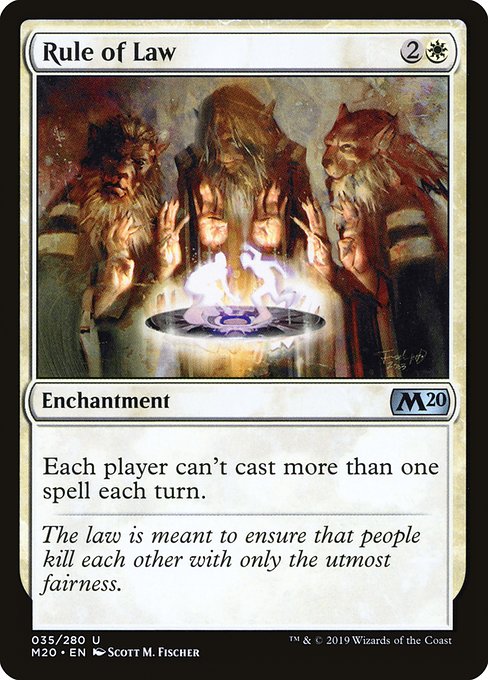


Table limits that keep stax playable and fair
Instead of banning “stax” broadly, set limits around outcomes.
Limit 1: No hard locks without a fast end
Example table rule:
- “If you assemble a deterministic lock, you need to demonstrate a win in the next turn cycle.”
Limit 2: Cap the density
Example:
- “No more than 8 stax pieces total” (you define what counts)
- “Only 3 global restriction pieces, the rest can be narrow hate”
Limit 3: Restrict the most miserable categories
Many casual pods are fine with:
- graveyard hate
- artifact/enchantment hate
- spell taxes
And less fine with:
- repeated untap denial
- mass resource denial with no clock
- effects that prevent basic game actions repeatedly
Limit 4: Match it to table power level
At higher power, stax is often a necessary safety valve against fast combo. At low power, it’s frequently punching down.
Rule 0 scripts for stax players and stax-averse tables
If you’re the stax player
“Heads up: this deck plays several stax/hate pieces that slow casting and activation. My goal is to stabilize, then end the game quickly. If that’s not the vibe, I can swap decks.”
If you want stax limits without banning it
“I’m fine with hate pieces and light taxes, but I’d rather avoid hard locks or untap denial. Can we keep stax to a ‘speed bump’ level?”
If you’re okay with stax but hate slow play
“Stax is fine. Can we agree that if someone lands a lock, they should either show the win line or we move to the next game?”
Playing stax fairly in-game
If you’ve disclosed and the table is in, the next step is execution.
- Sequence to minimize wasted time. Don’t play three restriction pieces when one wins the game.
- Break symmetry, but don’t hide the ball. Stax is already asymmetrical in practice. Being upfront reduces resentment.
- Know what your cards do. “Wait, how does this work again?” is brutal when the whole table is restricted.
How to play against stax and hate pieces
If your meta has stax, your deck should have answers. The format expects you to adapt, at least a little.
- Mulligan for interaction if you know it’s coming.
- Prioritize removing the piece that stops your deck’s entire plan.
- Pressure the stax player early, because once the board is constrained, it’s harder to meaningfully attack them.
FAQ
Is stax “allowed” in Commander?
Yes, but like many strategies, it lives or dies by the social contract and pregame expectations.
What’s the difference between stax and control?
Control answers threats. Stax prevents threats from being cast or used in the first place.
Are hate pieces always acceptable?
Not always. A silver-bullet hate piece can still be a “gotcha” if the table didn’t sign up for that kind of game.
What’s the simplest stax table rule?
“Disclose stax in Rule 0, and don’t lock the table without a quick finish.”
Wrap Up
Stax can be a fair way to keep powerful tables honest, but it demands more social care than most strategies. If you bring it, be clear about what it is and how you win. If you face it, pack interaction and attack the stax player early.