
If your graveyard hate is “hope,” you do not have graveyard hate. You have a plan to lose to the first deck that treats the graveyard like a second hand (because that is exactly what it is).
MTG Commander graveyard hate is one of those packages you only notice when you do not have it. Then you get dumpstered by recursion, reanimation, or a value engine that keeps looping the same threats until your removal spells start feeling like polite suggestions.
TLDR
- The “minimum package” for most Commander decks is 2–3 slots: one land-based hit plus one flexible piece, and optionally one repeatable tool.
- Pick your grave hate tier based on your meta: Light (1–2), Medium (3–5), Hard (6+).
- If your deck uses its own graveyard, avoid blanket nukes that shut you off. Run targeted or one-shot hate instead.
- Timing matters more than people think. Do not fire your hate early unless you are stopping a lethal line or denying a massive swing.
- Graveyard hate is a table-health card. It keeps games interactive, and it stops one player from playing the same turn four times in a row.
What “graveyard hate” actually means (and why you need it)
Graveyard hate is any card that does one or more of these jobs:
- Exiles a graveyard (one-shot nuke)
- Exiles cards as they would enter the graveyard (continuous effect)
- Stops casting or reanimating from graveyards (rules lock)
- Snipes key cards at instant speed (targeted denial)
- Forces fair play by shutting off death triggers and recursion engines
You do not need to become the “graveyard police.” You just need enough tools to stop the “I always have it” player from always having it.

When this land enters, exile target player's graveyard.
 : Add
: Add  .
.The 3 tiers of graveyard hate (light, medium, hard)
Think of this like seatbelts. Everyone should have some. Some tables need airbags. Some tables are basically a demolition derby.
Tier 1: Light graveyard hate (1–2 cards)
When this tier is correct:
- Your pod is mostly battlecruiser or mid-power.
- Graveyards show up, but they are not the main engine every game.
- You want low-opportunity-cost cards that are rarely dead.
What you are trying to do:
- Stop the occasional reanimation blowout.
- Deny the “I will just get it back” moment.
- Keep people honest without warping your deck.
Good light options often live on lands and cheap artifacts:
- Lands that exile a graveyard when they enter
- Artifacts that can exile one or all graveyards, then replace themselves
Pick one land-based option, then one flexible option you can hold up.

 , Sacrifice this artifact: Exile each opponent's graveyard., , Sacrifice this artifact: Draw a card.
Tier 2: Medium graveyard hate (3–5 cards)
When this tier is correct:
- Your meta is high-power, or your pod runs lots of recursion commanders.
- You regularly see reanimator, aristocrats, spellslinger recursion, or “value from the bin.”
- You have lost multiple games where the real problem was “their graveyard is a second hand.”
What you are trying to do:
- Have at least one repeatable hate piece.
- Have at least one instant-speed nuke or snipe.
- Have at least one continuous effect that forces different lines.
This tier is where you start mixing tools:
- One-shot nukes (keep opponents off a big turn)
- Repeatable targeted exile (pick apart key pieces)
- Lock pieces that change how graveyard decks function
A typical medium package might include an artifact nuke, a repeatable creature, and a continuous hate piece.

If a card would be put into an opponent's graveyard from anywhere, instead exile it with a void counter on it.
, Sacrifice this creature: Choose an exiled card an opponent owns with a void counter on it. You may play it this turn without paying its mana cost.Tier 3: Hard graveyard hate (6+ cards)
When this tier is correct:
- Your pod is cEDH-ish, or your local meta is heavy on graveyard-based win lines.
- You often see fast recursion and compact engines where one graveyard turn ends the game.
- You are building a deck that is comfortable playing hate as part of its identity (often control or stax-leaning shells).
What you are trying to do:
- Layer redundant hate so you can stick one through removal.
- Protect your hate or recur it.
- Force graveyard decks to play a totally different game, every game.
Hard packages often include multiple continuous effects, plus one-shot nukes, plus ways to find them. This is also where your tutor philosophy matters. If you are already playing tutors, you can treat graveyard hate as a “silver bullet” suite instead of raw density.
If you want the table-friendly way to approach this without starting a salt festival, read MTG Commander Stax and Hate Pieces: Guide for Playing Them Fairly after this.
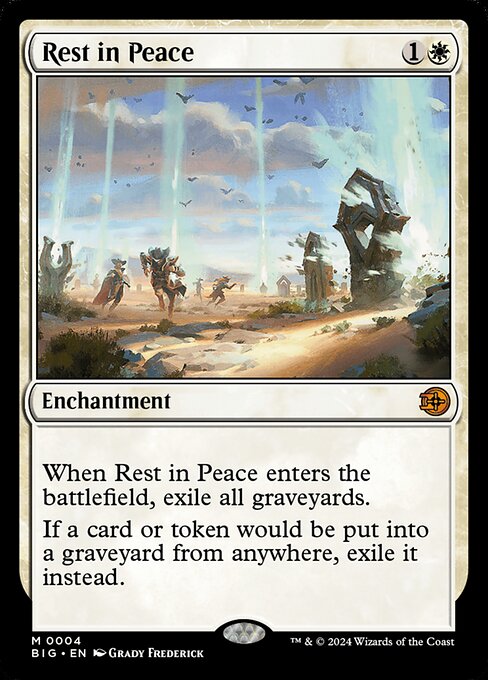

If a card or token would be put into a graveyard from anywhere, exile it instead.
“Minimum package” recommendations (the simple version)
Most decks, most metas: 2–3 slots
Here is the clean baseline that wins you games you would otherwise lose:
- 1 land-based hit (low opportunity cost)
- 1 flexible, hold-up piece (artifact or creature)
- Optional: 1 repeatable tool if your meta leans recursive
This covers the “oops, they have a graveyard” problem without clogging your hand.
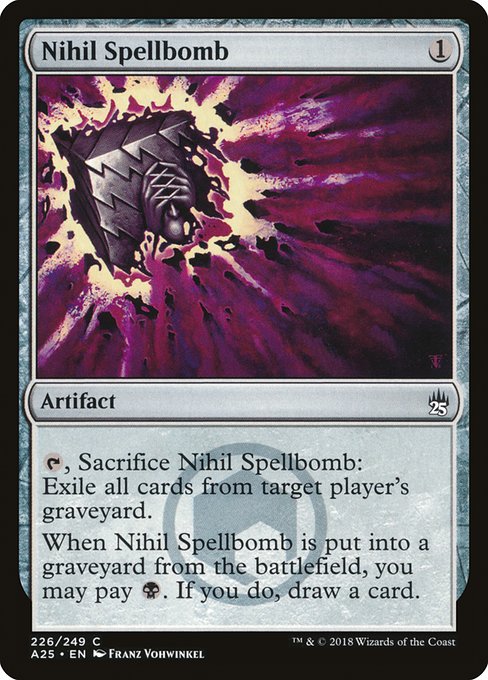 , Sacrifice this artifact: Exile target player's graveyard.
When this artifact is put into a graveyard from the battlefield, you may pay
. If you do, draw a card.High-power metas: 3–5 slots
- 1 land-based hit
- 1 instant-speed nuke
- 1 repeatable targeted exile
- 0–1 continuous hate piece
- Optional: 1 extra piece if your meta is saturated with graveyard decks
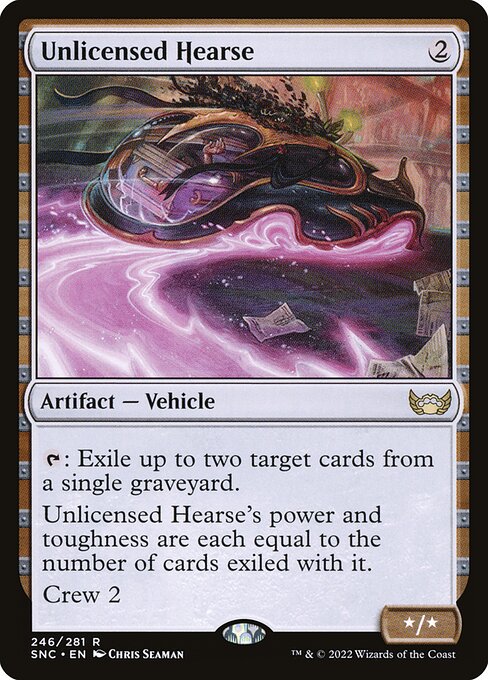
 : Exile up to two target cards from a single graveyard.
Unlicensed Hearse's power and toughness are each equal to the number of cards exiled with it.
Crew 2
cEDH-ish metas: pick hate that stops wins, not value
You are not trying to “slow down Muldrotha value.” You are trying to stop the lines that end the game.
This is where cards that exile as cards hit the graveyard or that deny casting from graveyards get much more important than a cute one-shot.
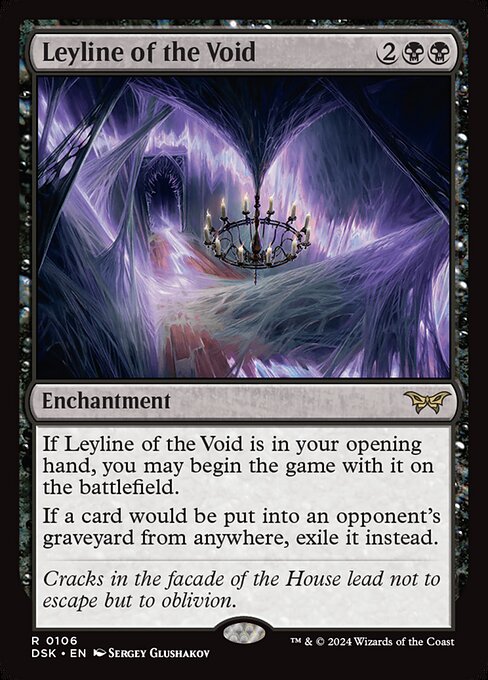
If a card would be put into an opponent's graveyard from anywhere, exile it instead.
Choose hate that does not brick your own deck
This is the part that makes people cut grave hate. They add a card that shuts down their own plan, then decide graveyard hate is “bad.”
If you rely on your own graveyard (reanimator, aristocrats, delve, flashback, recursion commanders), prioritize:
- Targeted exile effects (pick off key threats)
- One-shot nukes that you can time (hit them, then keep playing)
- Effects that do not blanket-exile everything forever
If you do not use your graveyard much, you can play the heavier continuous pieces with fewer downsides.
One classic fork:
- Blanket hate is powerful, but it hits everyone.
- Targeted hate is flexible, but it requires better timing.
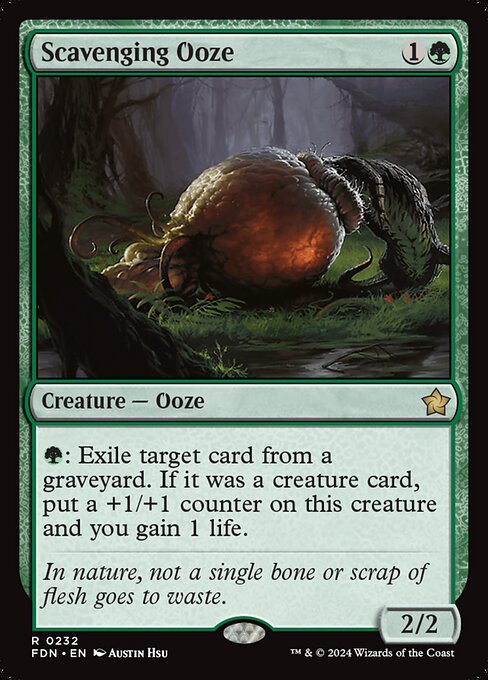
 : Exile target card from a graveyard. If it was a creature card, put a +1/+1 counter on this creature and you gain 1 life.
Timing: when to fire your graveyard hate (so it actually matters)
Bad timing is how you turn grave hate into a dead card. Good timing is how you steal games.
Hold your nuke until it denies a swing
Most graveyard decks have a “big turn” where the graveyard becomes mana, cards, or bodies. If you nuke the graveyard right before that turn, you do not just remove value. You remove the entire plan.
Snipe the enabler, not the payoff
If someone is setting up a recursion loop, you often want to exile the key enabler (the card that makes the loop possible) rather than the big threat they are looping.
Use hate proactively when you suspect a one-turn kill
In faster pods, the graveyard is not a slow value engine, it is a resource for winning immediately. That is the time to fire early, because “waiting for value” might mean “waiting to die.”
A lot of the scariest graveyard wins revolve around cards like Underworld Breach and friends. If your meta plays these lines, you want medium or hard-tier tools.
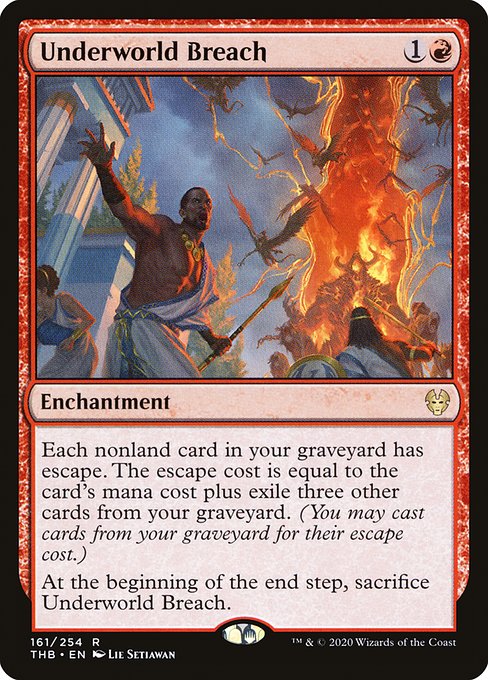

At the beginning of the end step, sacrifice this enchantment.
The graveyard hate checklist (quick tuning pass)
Use this when you are building or upgrading a deck:
- Do I have at least one land-based graveyard hit?
- Do I have at least one piece I can hold up at instant speed?
- Do I have at least one repeatable option if my meta is recursive?
- Does my hate choice conflict with my own game plan?
- Can I find it when I need it? (draw, tutors, redundancy)
- Do I have a plan for protecting it in high-power pods?
If you are already thinking in “packages” across the deck, the tutors conversation matters a lot here. A single tutor can turn a silver bullet into a real plan, which is why you should also read MTG Commander Tutors: When They’re Fine, When They Warp Games, and Table Limits after this.
Common mistakes (and how to stop making them)
- Only running one grave hate card. You will not draw it when you need it.
- Running a hate piece that shuts off your own deck. Then blaming the hate piece.
- Firing too early. A lot of the time, you should wait until it denies a big turn.
- Using grave hate like spot removal. Use it to break engines, not to feel productive.
- Ignoring the graveyard until it is too late. The graveyard deck is telling you what it is doing. Believe it.
FAQs
How many graveyard hate cards should I run in Commander?
Most decks should run 2–3. High-power metas often want 3–5. Dedicated hate shells can go 6+.
Is Bojuka Bog enough by itself?
Not usually. It is excellent as part of the package, but you still want at least one flexible piece you can hold up.
What if my deck uses its own graveyard?
Avoid blanket hate that shuts you off, and use targeted or timed one-shot exile instead.
Is Rest in Peace “too mean” for casual?
It depends on your pod. It is strong, and it changes how some decks function. If you include it, be intentional about your table expectations and be ready for people to prioritize removing it.
What is the biggest timing mistake with graveyard hate?
Firing it the moment a graveyard has cards in it. Wait until it denies a big turn or breaks an engine, unless you suspect an immediate win.
Wrap up
Graveyard hate is not about being annoying. It is about making sure the game stays interactive.
If you remember one thing: 2–3 pieces of well-chosen graveyard hate will save you more games than your third “cute value card” ever will.