
Your pod looks calm. Everyone is “just developing.” Then someone casts Living Death, or flashes back a spell you forgot about, or reanimates the exact creature you finally answered. Suddenly the graveyard is not a discard pile. It’s a second hand, and your opponents are drawing from it for free.
TLDR
- Run graveyard hate in Commander MTG, even in casual. The yard fills up naturally and a lot of wins route through it.
- Start with a “minimum package”: 1 slot if you must, 2 slots if you like winning more often, and a dedicated package if your meta is heavy on recursion or combo.
- The best graveyard hate is the kind you can hold up. Treat it like removal, not like a pregame ritual you fire on turn 2.
- If your deck uses its own graveyard, pick asymmetrical or surgical hate. If you do not, you can afford the hard locks.
If you are still building your deck skeleton, this plugs into the “packages that keep you from losing” part of our deckbuilding guide (see the references at the end for the internal link).
What is graveyard hate in Commander MTG?
“Graveyard hate” is any card that stops players from using the graveyard as a resource, usually by exiling cards, preventing cards from going there, or preventing spells and abilities from using them.
In Commander MTG, graveyard hate is less about hating out “the graveyard deck” and more about stopping the most common kind of free value in the format: replaying threats, rebuying answers, looping engines, and assembling combos out of the bin.
Also, reminder: the graveyard is not a special place where things go to retire. It’s a zone the rules explicitly support, and plenty of cards treat it like a toolbox. (More on that in the References section.)
Why you need graveyard hate even in casual pods
1) “Accidental graveyard decks” are everywhere
You do not need to be a self-mill commander to have a stocked graveyard. Commander games naturally produce graveyards because:
- Creatures trade off or get wiped.
- People loot, rummage, cycle, surveil, mill, and discard.
- Instants and sorceries resolve and go there.
- Fetch lands and sacrifice effects add up over a long game.
By midgame, most players have a graveyard full of options. If you are not interacting with that, you are letting them play with extra cards.
2) A lot of common wins touch the yard
This is the sneaky part: many combo lines either start in the graveyard or become resilient because of it.
Example: Underworld Breach is a poster child for this. As of early 2026, Commander Spellbook lists dozens of Commander-legal combos involving it. That’s one card. One.
If you want proof at a glance, our Combo Database exists for exactly this reason (internal link at the end).
3) Graveyard hate is one of the cheapest “oops-proofing” slots
A single piece of hate can turn an opponent’s best turn into a shrug. The trick is choosing hate that fits your deck and timing it correctly.
The three jobs graveyard hate actually does
Most players think “graveyard hate = exile their whole graveyard.” That’s one job, and it’s not always the best one.
Job A: Break targeted recursion
This is your Reanimate, Animate Dead, Regrowth, Eternal Witness style problem. The opponent targets something in the yard. You remove that card or empty the graveyard in response, and their spell can fail to resolve if all its targets become illegal.
Job B: Stop “cast from graveyard” engines
This is flashback, escape, and effects that let players cast spells from graveyards. These decks do not care if you exile one card. They care if you stop the whole pipeline.
Job C: Prevent the graveyard from being a resource at all
This is the “hard mode” option: replacement effects or static hate that says “nope, those cards are not going to hang out in the yard.”
This is powerful, but it can create table friction and it can absolutely brick your own deck if you are not careful.
The minimum package framework: one-slot, two-slot, dedicated
Here’s the MTGEDH way to think about this: you are not trying to become a hate deck. You are trying to pay a small tax now to avoid losing to the same class of problems forever.
One-slot package (1 card)
This is for decks that are tight on space or very synergistic, but still want a safety valve.
Your goal: one piece that is low opportunity cost and usually live.
Good one-slot picks
- Bojuka Bog (if you are in black): a land slot that also nukes a graveyard.
- Scavenger Grounds: a land slot that can wipe graveyards when you need it.
- Soul-Guide Lantern: cheap, flexible, and does not demand a full commitment.
- Relic of Progenitus: repeatable pressure, and you can cash it in when it matters.
- Nihil Spellbomb: especially nice if you can reliably draw off it.
When one slot is enough
- Your meta is mostly battlecruiser, but someone occasionally loops value.
- You are mostly worried about one big “reanimate the bomb” moment.
- You want a card that turns “I lose to Living Death” into “I have a chance.”
When one slot is not enough
- Your pod has regular graveyard decks.
- You keep seeing recurring engines (Meren-style loops, flashback piles, Breach turns).
- You are playing higher power where graveyard interaction is part of the baseline.
Two-slot package (2 cards)
This is the sweet spot for most Commander MTG decks.
Your goal: cover both targeted recursion and big graveyard turns.
The cleanest pairing looks like this:
- Slot 1: a surgical or repeatable piece (keeps honest players honest)
- Slot 2: an emergency button (stops the “I am about to die” turn)
Example pairings
- Soul-Guide Lantern + Scavenger Grounds
- Relic of Progenitus + Bojuka Bog
- Nihil Spellbomb + a second, different effect (so you are not cold to one style of graveyard use)
Why two slots feels so much better than one
With one slot, you often have to fire it early because you are scared of missing your window. With two slots, you can play actual Magic: hold one, use one, and keep the other as backup.
Dedicated package (4–6 cards)
This is for metas where graveyards are a primary resource, or for pods where combo lines regularly involve the yard.
Your goal: have interaction density, not a single silver bullet.
A good dedicated package usually includes:
- 1–2 repeatable pieces (pressure, slows setup)
- 1–2 instant-speed “gotcha” pieces (punishes the commit turn)
- 1–2 broad shutdown effects (optional, depending on your deck and pod)
Dedicated package staples
- Repeatable: Scavenging Ooze, Lion Sash, Unlicensed Hearse, Dauthi Voidwalker
- Instant-speed buttons: Tormod’s Crypt, Soul-Guide Lantern, Nihil Spellbomb, Endurance (if you want the shuffle effect)
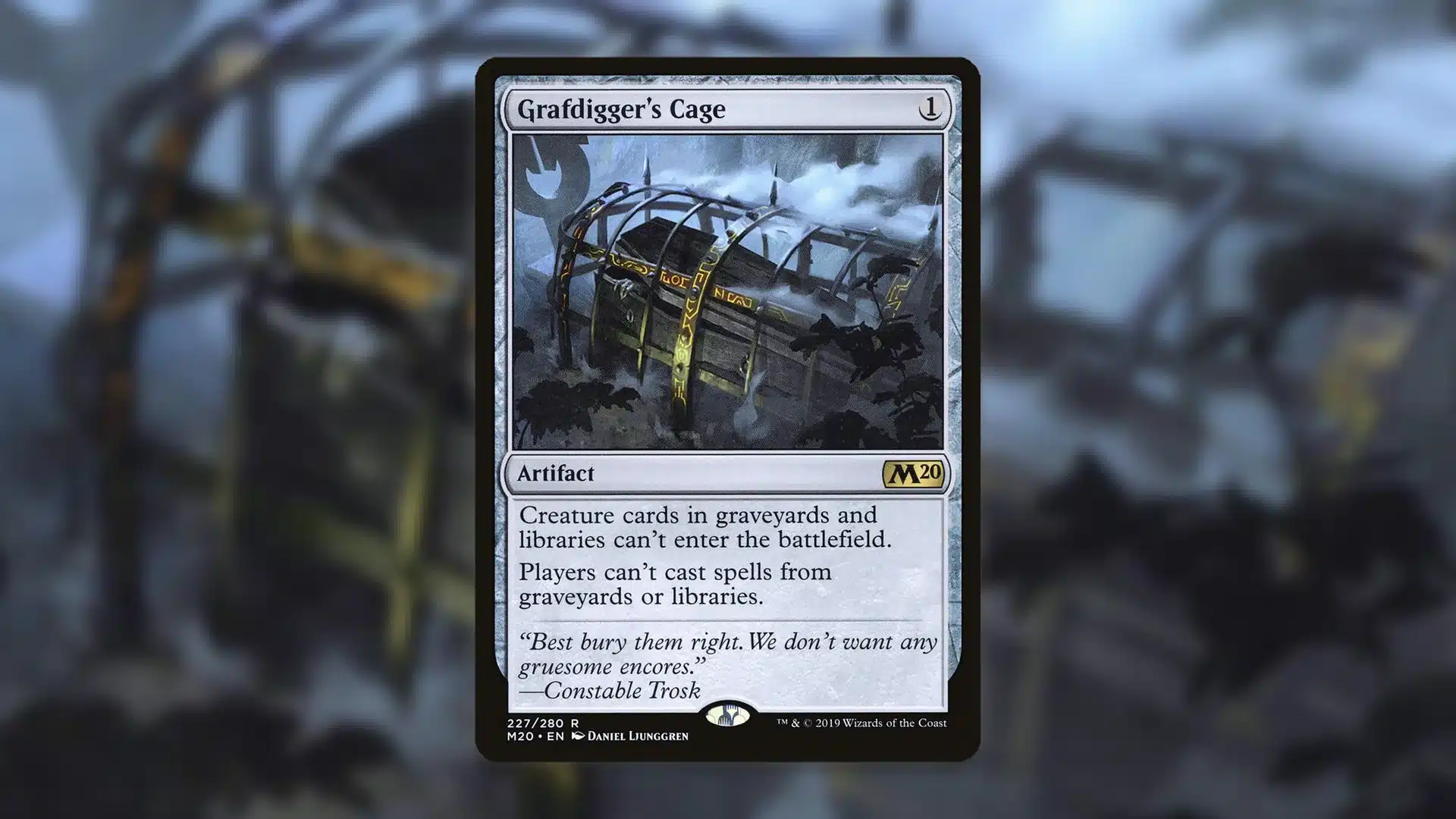
- Broad shutdown: Rest in Peace, Leyline of the Void, Grafdigger’s Cage, Weathered Runestone
If you are bringing hard shutdown pieces, do yourself a favor and treat it like a Rule 0 topic. Not because it is “mean,” but because it can invalidate someone’s entire strategy.
How to pick graveyard hate that does not brick your own deck
This is the part most lists miss. You do not want “the best graveyard hate.” You want the best graveyard hate for your deck’s relationship with its own graveyard.
If your deck uses its own graveyard a lot
Examples: reanimator, aristocrats recursion, flashback/escape spellslinger, self-mill value.
Avoid as default
- Rest in Peace and Leyline of the Void style effects (they often shut off your own plan)
- Heavy “exile everything always” effects unless they are one-shot and timed
Prefer
- Asymmetrical exile (hit opponents, leave your yard alone)
- Surgical removal (pick the key card that matters)
- Delayed buttons (hold up a nuke for emergencies)
Good fits:
- Bojuka Bog (hits one opponent, you pick the moment)
- Soul-Guide Lantern (flexible mode choice)
- Scavenger Grounds (you choose when, yes it hits you too, but you control the timing)
- Creature-based hate like Scavenging Ooze and Lion Sash (you can eat only what you need)
If your deck barely cares about its graveyard
Examples: many creature-based midrange decks, some Voltron builds, plenty of tribal decks.
You can afford the hard locks
- Rest in Peace and Leyline of the Void get much stronger when you are not collateral damage.
- Grafdigger’s Cage and similar effects can shut off huge swaths of recursion.
This is also where you can justify hate that doubles as a win plan. For example, Dauthi Voidwalker both disrupts graveyards and can steal something game-ending.
If you are somewhere in the middle
Most decks live here. You are not “a graveyard deck,” but you do have recursion, you do have a few cards you like to rebuy, and you do not want to turn off your own value.
Default recommendation
- Start with the two-slot package.
- Make one of the slots a land if you can, so it feels like free inclusion.
- Keep your hate as optional and timed, not permanently on.
How to actually use graveyard hate without wasting it
This is your “I put it in the deck, now what” section.
Treat graveyard hate like removal, not like a pregame buff
If you fire off your Bojuka Bog on turn 3 because someone has four cards in the yard, you are probably just doing table theater.
A better mindset:
- Hold your hate until it saves you or stops a major swing.
- Use it in response to a spell or ability when possible.
The single most important timing trick
If a spell targets a card in a graveyard, and you remove that target, the spell can fail to resolve if all targets are illegal. This is why graveyard hate feels like a counterspell sometimes.
Practical example:
- Opponent casts a reanimation spell targeting a creature in their graveyard.
- You crack Soul-Guide Lantern (or similar) to exile that creature.
- If that spell now has no legal targets, it does not resolve.
Do not forget that exile is a real zone
Exiling is not “extra dead.” It is its own zone with its own rules.
That matters because some decks can still access exiled cards, but far fewer can.
Commander-specific edge case: “Does this stop my commander?”
If your commander would die and a card exiles it instead of putting it into the graveyard, the commander can still end up back in the command zone via Commander rules. The commander may be put into the command zone if it is in a graveyard or exile and got there since the last time state-based actions were checked.
What this means at the table:
- Graveyard hate can stop “dies” triggers if it prevents the card from going to the graveyard (because “dies” specifically means “put into a graveyard from the battlefield”).
- It usually does not permanently trap commanders in exile unless another effect specifically prevents the move.
Common mistakes that make graveyard hate feel bad
Mistake 1: Running one piece that only stops one type of graveyard use
If your only hate is “creatures can’t enter from graveyards,” you might still lose to “cast spells from the graveyard.” Cover at least two angles if your meta calls for it.
Mistake 2: Firing too early because you are scared
Two-slot packages fix this. So does experience. Your hate is at its best when it is a threat your opponents must respect.
Mistake 3: Playing a hard lock that shuts off your own deck
If you need your graveyard, do not volunteer to turn it off unless you are winning immediately after.
Mistake 4: Forgetting multiplayer math
In a four-player game, you have three opponents. If your graveyard hate only hits one graveyard, you want to make sure you are hitting the player who is actually about to profit.
FAQs
How many graveyard hate cards should I run in Commander MTG?
Start at two for most decks. Go down to one if you are extremely tight on slots, and go up to a dedicated package if your pod regularly wins through graveyard lines.
Is Bojuka Bog enough by itself?
Sometimes, especially in slower casual pods. The problem is that it hits one player and it is not instant-speed. If your meta is faster, pair it with an instant-speed option.
Does graveyard hate stop “dies” triggers?
Only if it prevents the permanent from actually going to the graveyard. “Dies” means “put into a graveyard from the battlefield.”
When should I crack Relic of Progenitus or Soul-Guide Lantern?
When it either:
- Stops a targeted recursion spell in progress, or
- Prevents a big graveyard turn that will swing the game
If you crack it just to feel productive, you are often giving your opponents time to rebuild.